


Test BatterY Training
Dyslexia Assessments and Identification
Dyslexia Assessments and Identification


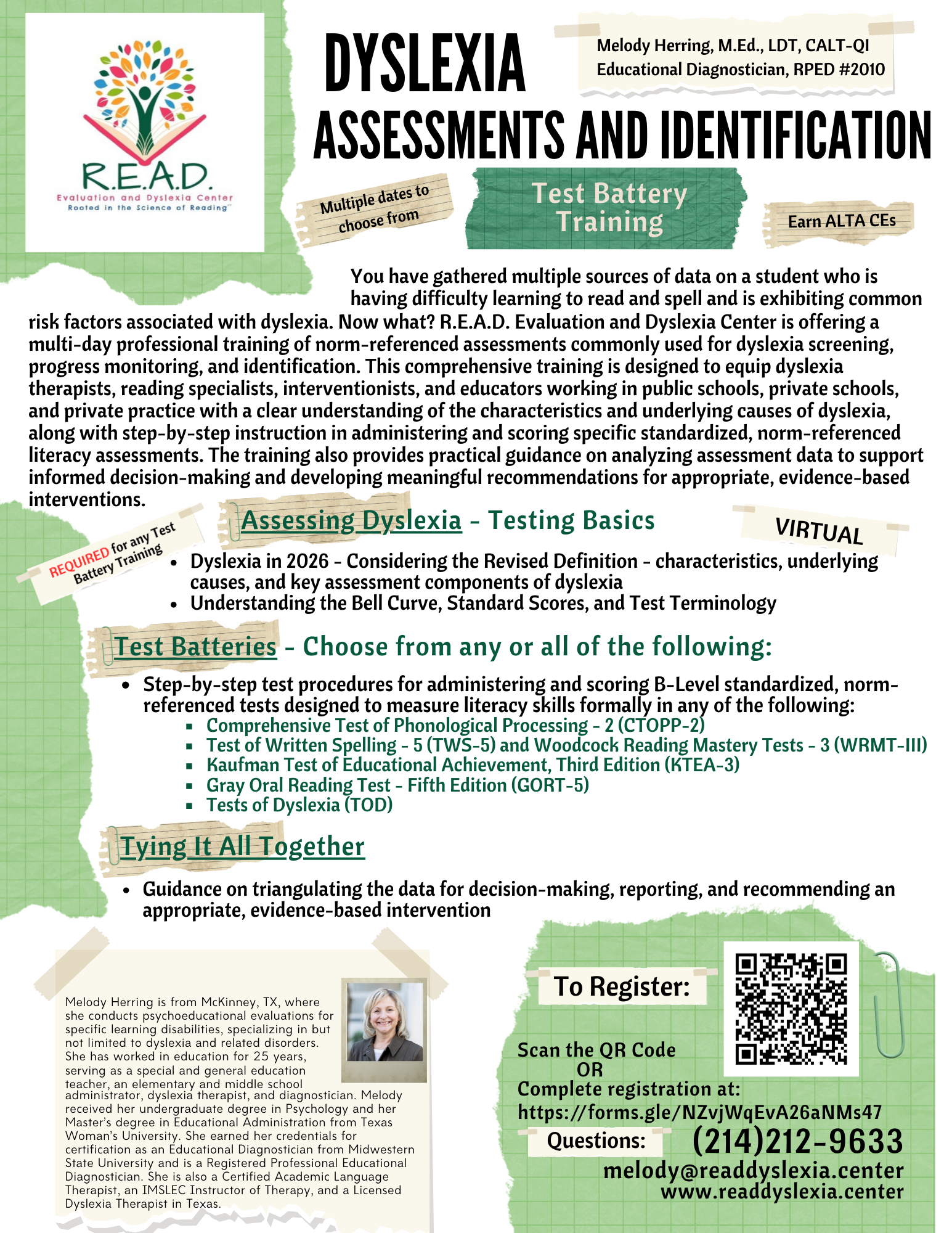
You have gathered multiple sources of data on a student who is having difficulty learning to read and spell and is exhibiting common risk factors associated with dyslexia. Now what?
R.E.A.D. Evaluation and Dyslexia Center is offering a multi-day professional training of norm-referenced assessments commonly used for dyslexia screening, progress monitoring, and identification. This comprehensive training is designed to equip dyslexia therapists, reading specialists, interventionists, and educators working in public schools, private schools, and private practice with a clear understanding of the characteristics and underlying causes of dyslexia, along with step-by-step instruction in administering and scoring specific standardized, norm-referenced literacy assessments. The training also provides practical guidance on analyzing assessment data to support informed decision-making and developing meaningful recommendations for appropriate, evidence-based interventions.
Assessing Dyslexia: Test Battery Training
Assessing Dyslexia: Assessments and Identification (REQUIRED for any Test Battery Training)
Dyslexia in 2026 - Considering the Revised Definition
Testing Basics / Terminology
Bell Curve / Scores
Test Batteries - Choose from any of the following:
Comprehensive Test of Phonological Processing - 2 (CTOPP-2)
Kaufman Test of Educational Achievement, Third Edition (KTEA-3) (Full battery)
Gray Oral Reading Test - Fifth Edition (GORT-5)
Tests of Dyslexia (TOD)
(A comprehensive assessment may include the CTOPP, KTEA, and GORT, or the TOD alone. The cost of the three test batteries is approximately the same as the TOD. You may choose to attend any or all options. Please reach out if you have questions about which option best fits your needs.)
Tying It All Together
Guidance on triangulating the data for decision-making, reporting, and recommending an appropriate, evidence-based intervention
* Registration for Assessing Dyslexia is required with any test battery training, and Tying It All Together is HIGHLY recommended.
* You may attend Assessing Dyslexia and/or Tying It All Together without attending any test battery sessions.
** See below for more information
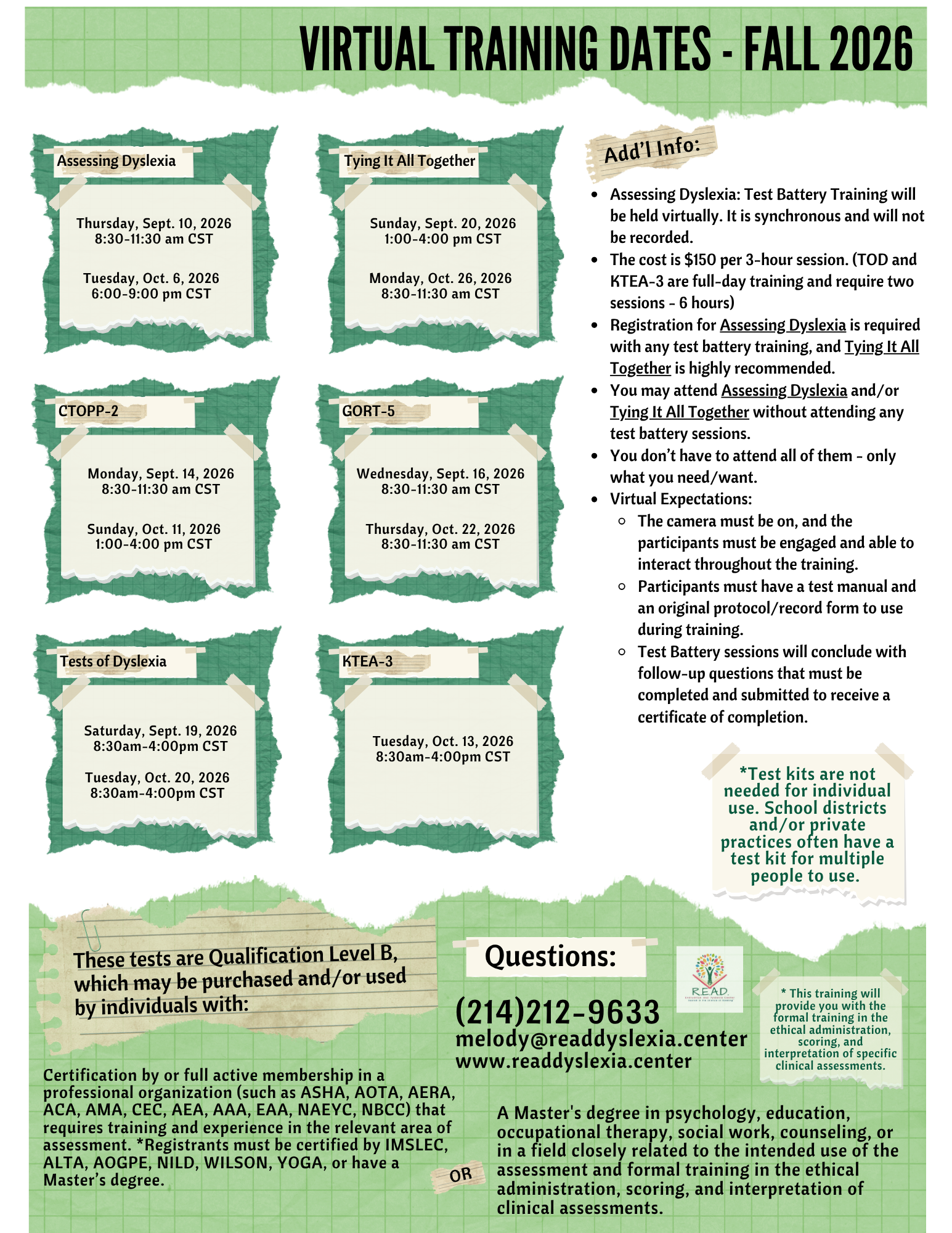
Fall training Dates
Assessing Dyslexia - Oct. 6
CTOPP-2 - Oct. 11
GORT-5: NU - Oct. 22
TOD - Sept. 19, Oct. 20
KTEA-3 - Oct. 13
Tying It All Together - Sept. 20, Oct. 26
Virtual
Assessing Dyslexia - Assessments and Identification
Assessing Dyslexia: Foundations of Testing
This prerequisite training is required before enrolling in any test‑battery training. It establishes the essential knowledge base needed for test administration and practice. All content is aligned with the new IDA definition of dyslexia, ensuring participants are grounded in the most current, research‑supported understanding.
What You’ll Learn
Dyslexia in 2026 - Considering the Revised Definition
Core Characteristics - Common risk factors, patterns, and learner profiles across ages.
Underlying Causes - cognitive and linguistic factors associated with dyslexia.
Key Terminology
Understanding the Bell Curve & Standard Scores
Testing Basics

Comprehensive Test of Phonological Processing - 2 (CTOPP-2)
CTOPP-2 Administration Training
This training provides in-depth preparation for professionals seeking to competently administer, score, and interpret the Comprehensive Test of Phonological Processing–Second Edition (CTOPP-2).
Overview of the CTOPP-2 and its role in reading and dyslexia assessment
Step-by-step standardized administration procedures
Accurate scoring and interpretation of subtests and composite scores
Understanding phonological awareness, phonological memory, and rapid naming
Using CTOPP-2 results to guide instruction, intervention, and evaluation planning
Designed for educators, reading specialists, dyslexia therapists, and related professionals

Kaufman Test of Educational Achievement–Third Edition (KTEA-3)
KTEA-3 Administration Training
This session prepares professionals to administer, score, and interpret the remaining KTEA-3 subtests.
Overview of the KTEA-3 and its role in academic achievement assessment
Standardized administration and scoring procedures
Interpretation of reading, written language, and mathematics subtests and composites
Identifying academic strengths and areas of need
Using KTEA-3 data to guide instruction, intervention, and evaluation planning
Designed for educators, reading specialists, dyslexia therapists, psychologists, and related professionals
Tests of Dyslexia (TOD)
TOD Administration Training
This training prepares professionals to administer, score, and interpret the Tests of Dyslexia (TOD), a comprehensive, norm-referenced assessment designed to evaluate the core components associated with dyslexia, including phonological awareness, rapid naming, word reading, decoding, spelling, and reading fluency.
Overview of the Tests of Dyslexia (TOD) and its role in dyslexia assessment
Standardized administration and scoring procedures across all TOD subtests
Interpretation of results related to phonological processing, reading, spelling, and fluency
Understanding dyslexia profiles and patterns of strengths and weaknesses
Using TOD data to support identification, instruction, and intervention planning

Gray Oral Reading Test - Fifth Edition (GORT-5)
GORT-5 Administration Training
This training prepares professionals to administer, score, and interpret the Gray Oral Reading Test–Fifth Edition (GORT-5), a norm-referenced assessment of oral reading skills including rate, accuracy, fluency, and comprehension.
Overview of the GORT-5 and its role in oral reading assessment
Standardized administration and scoring procedures
Interpretation of rate, accuracy, fluency, and comprehension scores
Evaluating reading performance using connected text
Identifying reading strengths and areas of need
Using GORT-5 results to guide instruction, intervention, and evaluation decisions

Tying It All Together
Tying It All Together
This training is HIGHLY recommended with any test battery training and provides guidance on triangulating the data for decision-making, reporting, and recommending an appropriate, evidence-based intervention. All content is aligned with the new IDA definition of dyslexia, ensuring participants are grounded in the most current, research‑supported understanding.
What You’ll Learn
Dyslexia in 2026 - Considering the Revised Definition
Additional Considerations
Recommendations
Reporting
Case Study
Tying It All Together
Tying It All Together
This training is HIGHLY recommended with any test battery training and provides guidance on triangulating the data for decision-making, reporting, and recommending an appropriate, evidence-based intervention. All content is aligned with the new IDA definition of dyslexia, ensuring participants are grounded in the most current, research‑supported understanding.
What You’ll Learn
Dyslexia in 2026 - Considering the Revised Definition
Additional Considerations
Recommendations
Reporting
Case Study
Tests of Dyslexia (TOD)
TOD Administration Training
This training prepares professionals to administer, score, and interpret the Tests of Dyslexia (TOD), a comprehensive, norm-referenced assessment designed to evaluate the core components associated with dyslexia, including phonological awareness, rapid naming, word reading, decoding, spelling, and reading fluency.
Overview of the Tests of Dyslexia (TOD) and its role in dyslexia assessment
Standardized administration and scoring procedures across all TOD subtests
Interpretation of results related to phonological processing, reading, spelling, and fluency
Understanding dyslexia profiles and patterns of strengths and weaknesses
Using TOD data to support identification, instruction, and intervention planning
Gray Oral Reading Test - Fifth Edition (GORT-5)
GORT-5 Administration Training
This training prepares professionals to administer, score, and interpret the Gray Oral Reading Test–Fifth Edition (GORT-5), a norm-referenced assessment of oral reading skills including rate, accuracy, fluency, and comprehension.
Overview of the GORT-5 and its role in oral reading assessment
Standardized administration and scoring procedures
Interpretation of rate, accuracy, fluency, and comprehension scores
Evaluating reading performance using connected text
Identifying reading strengths and areas of need
Using GORT-5 results to guide instruction, intervention, and evaluation decisions
Comprehensive Test of Phonological Processing - 2 (CTOPP-2)
CTOPP-2 Administration Training
This training provides in-depth preparation for professionals seeking to competently administer, score, and interpret the Comprehensive Test of Phonological Processing–Second Edition (CTOPP-2).
Overview of the CTOPP-2 and its role in reading and dyslexia assessment
Step-by-step standardized administration procedures
Accurate scoring and interpretation of subtests and composite scores
Understanding phonological awareness, phonological memory, and rapid naming
Using CTOPP-2 results to guide instruction, intervention, and evaluation planning
Designed for educators, reading specialists, dyslexia therapists, and related professionals
Assessing Dyslexia - Assessments and Identification
Assessing Dyslexia: Foundations of Testing
This prerequisite training is required before enrolling in any test‑battery training. It establishes the essential knowledge base needed for test administration and practice. All content is aligned with the new IDA definition of dyslexia, ensuring participants are grounded in the most current, research‑supported understanding.
What You’ll Learn
Dyslexia in 2026 - Considering the Revised Definition
Core Characteristics - Common risk factors, patterns, and learner profiles across ages.
Underlying Causes - cognitive and linguistic factors associated with dyslexia.
Key Terminology
Understanding the Bell Curve & Standard Scores
Testing Basics
Gray Oral Reading Test - Fifth Edition (GORT-5)
GORT-5 Administration Training
This training prepares professionals to administer, score, and interpret the Gray Oral Reading Test–Fifth Edition (GORT-5), a norm-referenced assessment of oral reading skills including rate, accuracy, fluency, and comprehension.
Overview of the GORT-5 and its role in oral reading assessment
Standardized administration and scoring procedures
Interpretation of rate, accuracy, fluency, and comprehension scores
Evaluating reading performance using connected text
Identifying reading strengths and areas of need
Using GORT-5 results to guide instruction, intervention, and evaluation decisions
Comprehensive Test of Phonological Processing - 2 (CTOPP-2)
CTOPP-2 Administration Training
This training provides in-depth preparation for professionals seeking to competently administer, score, and interpret the Comprehensive Test of Phonological Processing–Second Edition (CTOPP-2).
Overview of the CTOPP-2 and its role in reading and dyslexia assessment
Step-by-step standardized administration procedures
Accurate scoring and interpretation of subtests and composite scores
Understanding phonological awareness, phonological memory, and rapid naming
Using CTOPP-2 results to guide instruction, intervention, and evaluation planning
Designed for educators, reading specialists, dyslexia therapists, and related professionals
Tying It All Together
Tying It All Together
This training is HIGHLY recommended with any test battery training and provides guidance on triangulating the data for decision-making, reporting, and recommending an appropriate, evidence-based intervention. All content is aligned with the new IDA definition of dyslexia, ensuring participants are grounded in the most current, research‑supported understanding.
What You’ll Learn
Dyslexia in 2026 - Considering the Revised Definition
Additional Considerations
Recommendations
Reporting
Case Study
Tests of Dyslexia (TOD)
TOD Administration Training
This training prepares professionals to administer, score, and interpret the Tests of Dyslexia (TOD), a comprehensive, norm-referenced assessment designed to evaluate the core components associated with dyslexia, including phonological awareness, rapid naming, word reading, decoding, spelling, and reading fluency.
Overview of the Tests of Dyslexia (TOD) and its role in dyslexia assessment
Standardized administration and scoring procedures across all TOD subtests
Interpretation of results related to phonological processing, reading, spelling, and fluency
Understanding dyslexia profiles and patterns of strengths and weaknesses
Using TOD data to support identification, instruction, and intervention planning
Kaufman Test of Educational Achievement–Third Edition (KTEA-3)
KTEA-3 Administration Training
This session prepares professionals to administer, score, and interpret the remaining KTEA-3 subtests.
Overview of the KTEA-3 and its role in academic achievement assessment
Standardized administration and scoring procedures
Interpretation of reading, written language, and mathematics subtests and composites
Identifying academic strengths and areas of need
Using KTEA-3 data to guide instruction, intervention, and evaluation planning
Designed for educators, reading specialists, dyslexia therapists, psychologists, and related professionals
Assessing Dyslexia - Assessments and Identification
Assessing Dyslexia: Foundations of Testing
This prerequisite training is required before enrolling in any test‑battery training. It establishes the essential knowledge base needed for test administration and practice. All content is aligned with the new IDA definition of dyslexia, ensuring participants are grounded in the most current, research‑supported understanding.
What You’ll Learn
Dyslexia in 2026 - Considering the Revised Definition
Core Characteristics - Common risk factors, patterns, and learner profiles across ages.
Underlying Causes - cognitive and linguistic factors associated with dyslexia.
Key Terminology
Understanding the Bell Curve & Standard Scores
Testing Basics
Gray Oral Reading Test - Fifth Edition (GORT-5)
GORT-5 Administration Training
This training prepares professionals to administer, score, and interpret the Gray Oral Reading Test–Fifth Edition (GORT-5), a norm-referenced assessment of oral reading skills including rate, accuracy, fluency, and comprehension.
Overview of the GORT-5 and its role in oral reading assessment
Standardized administration and scoring procedures
Interpretation of rate, accuracy, fluency, and comprehension scores
Evaluating reading performance using connected text
Identifying reading strengths and areas of need
Using GORT-5 results to guide instruction, intervention, and evaluation decisions
Tying It All Together
Tying It All Together
This training is HIGHLY recommended with any test battery training and provides guidance on triangulating the data for decision-making, reporting, and recommending an appropriate, evidence-based intervention. All content is aligned with the new IDA definition of dyslexia, ensuring participants are grounded in the most current, research‑supported understanding.
What You’ll Learn
Dyslexia in 2026 - Considering the Revised Definition
Additional Considerations
Recommendations
Reporting
Case Study
Comprehensive Test of Phonological Processing - 2 (CTOPP-2)
CTOPP-2 Administration Training
This training provides in-depth preparation for professionals seeking to competently administer, score, and interpret the Comprehensive Test of Phonological Processing–Second Edition (CTOPP-2).
Overview of the CTOPP-2 and its role in reading and dyslexia assessment
Step-by-step standardized administration procedures
Accurate scoring and interpretation of subtests and composite scores
Understanding phonological awareness, phonological memory, and rapid naming
Using CTOPP-2 results to guide instruction, intervention, and evaluation planning
Designed for educators, reading specialists, dyslexia therapists, and related professionals
Assessing Dyslexia - Assessments and Identification
Assessing Dyslexia: Foundations of Testing
This prerequisite training is required before enrolling in any test‑battery training. It establishes the essential knowledge base needed for test administration and practice. All content is aligned with the new IDA definition of dyslexia, ensuring participants are grounded in the most current, research‑supported understanding.
What You’ll Learn
Dyslexia in 2026 - Considering the Revised Definition
Core Characteristics - Common risk factors, patterns, and learner profiles across ages.
Underlying Causes - cognitive and linguistic factors associated with dyslexia.
Key Terminology
Understanding the Bell Curve & Standard Scores
Testing Basics
Tying It All Together
Tying It All Together
This training is HIGHLY recommended with any test battery training and provides guidance on triangulating the data for decision-making, reporting, and recommending an appropriate, evidence-based intervention. All content is aligned with the new IDA definition of dyslexia, ensuring participants are grounded in the most current, research‑supported understanding.
What You’ll Learn
Dyslexia in 2026 - Considering the Revised Definition
Additional Considerations
Recommendations
Reporting
Case Study
Tests of Dyslexia (TOD)
TOD Administration Training
This training prepares professionals to administer, score, and interpret the Tests of Dyslexia (TOD), a comprehensive, norm-referenced assessment designed to evaluate the core components associated with dyslexia, including phonological awareness, rapid naming, word reading, decoding, spelling, and reading fluency.
Overview of the Tests of Dyslexia (TOD) and its role in dyslexia assessment
Standardized administration and scoring procedures across all TOD subtests
Interpretation of results related to phonological processing, reading, spelling, and fluency
Understanding dyslexia profiles and patterns of strengths and weaknesses
Using TOD data to support identification, instruction, and intervention planning
Assessing Dyslexia - Assessments and Identification
Assessing Dyslexia: Foundations of Testing
This prerequisite training is required before enrolling in any test‑battery training. It establishes the essential knowledge base needed for test administration and practice. All content is aligned with the new IDA definition of dyslexia, ensuring participants are grounded in the most current, research‑supported understanding.
What You’ll Learn
Dyslexia in 2026 - Considering the Revised Definition
Core Characteristics - Common risk factors, patterns, and learner profiles across ages.
Underlying Causes - cognitive and linguistic factors associated with dyslexia.
Key Terminology
Understanding the Bell Curve & Standard Scores
Testing Basics
Tying It All Together
Tying It All Together
This training is HIGHLY recommended with any test battery training and provides guidance on triangulating the data for decision-making, reporting, and recommending an appropriate, evidence-based intervention. All content is aligned with the new IDA definition of dyslexia, ensuring participants are grounded in the most current, research‑supported understanding.
What You’ll Learn
Dyslexia in 2026 - Considering the Revised Definition
Additional Considerations
Recommendations
Reporting
Case Study
Kaufman Test of Educational Achievement–Third Edition (KTEA-3): Dyslexia Index
KTEA-3 Dyslexia Index Training
This session prepares professionals to administer, score, and interpret the KTEA-3 Dyslexia Index, an efficient, norm-referenced screener designed to identify academic patterns commonly associated with dyslexia.
Overview of the KTEA-3 Dyslexia Index and its role as a dyslexia screener
Standardized administration and scoring of Dyslexia Index subtests
Using Dyslexia Index results to guide screening, intervention, and referral decisions
Designed for educators, reading specialists, dyslexia therapists, and related professionals
Kaufman Test of Educational Achievement–Third Edition (KTEA-3) - FULL BATTERY
KTEA-3 Administration Training
This session prepares professionals to administer, score, and interpret the remaining KTEA-3 subtests.
Overview of the KTEA-3 and its role in academic achievement assessment
Standardized administration and scoring procedures
Interpretation of reading, written language, and mathematics subtests and composites
Identifying academic strengths and areas of need
Using KTEA-3 data to guide instruction, intervention, and evaluation planning
Designed for educators, reading specialists, dyslexia therapists, psychologists, and related professionals
Gray Oral Reading Test - Fifth Edition (GORT-5)
GORT-5 Administration Training
This training prepares professionals to administer, score, and interpret the Gray Oral Reading Test–Fifth Edition (GORT-5), a norm-referenced assessment of oral reading skills including rate, accuracy, fluency, and comprehension.
Overview of the GORT-5 and its role in oral reading assessment
Standardized administration and scoring procedures
Interpretation of rate, accuracy, fluency, and comprehension scores
Evaluating reading performance using connected text
Identifying reading strengths and areas of need
Using GORT-5 results to guide instruction, intervention, and evaluation decisions
Tests of Dyslexia (TOD)
TOD Administration Training
This training prepares professionals to administer, score, and interpret the Tests of Dyslexia (TOD), a comprehensive, norm-referenced assessment designed to evaluate the core components associated with dyslexia, including phonological awareness, rapid naming, word reading, decoding, spelling, and reading fluency.
Overview of the Tests of Dyslexia (TOD) and its role in dyslexia assessment
Standardized administration and scoring procedures across all TOD subtests
Interpretation of results related to phonological processing, reading, spelling, and fluency
Understanding dyslexia profiles and patterns of strengths and weaknesses
Using TOD data to support identification, instruction, and intervention planning
Comprehensive Test of Phonological Processing - 2 (CTOPP-2)
CTOPP-2 Administration Training
This training provides in-depth preparation for professionals seeking to competently administer, score, and interpret the Comprehensive Test of Phonological Processing–Second Edition (CTOPP-2).
Overview of the CTOPP-2 and its role in reading and dyslexia assessment
Step-by-step standardized administration procedures
Accurate scoring and interpretation of subtests and composite scores
Understanding phonological awareness, phonological memory, and rapid naming
Using CTOPP-2 results to guide instruction, intervention, and evaluation planning
Designed for educators, reading specialists, dyslexia therapists, and related professionals
Assessing Dyslexia - Assessments and Identification
Assessing Dyslexia: Foundations of Testing
This prerequisite training is required before enrolling in any test‑battery training. It establishes the essential knowledge base needed for test administration and practice. All content is aligned with the new IDA definition of dyslexia, ensuring participants are grounded in the most current, research‑supported understanding.
What You’ll Learn
Dyslexia in 2026 - Considering the Revised Definition
Core Characteristics - Common risk factors, patterns, and learner profiles across ages.
Underlying Causes - cognitive and linguistic factors associated with dyslexia.
Key Terminology
Understanding the Bell Curve & Standard Scores
Testing Basics
Tying It All Together
Tying It All Together
This training is HIGHLY recommended with any test battery training and provides guidance on triangulating the data for decision-making, reporting, and recommending an appropriate, evidence-based intervention. All content is aligned with the new IDA definition of dyslexia, ensuring participants are grounded in the most current, research‑supported understanding.
What You’ll Learn
Dyslexia in 2026 - Considering the Revised Definition
Additional Considerations
Recommendations
Reporting
Case Study
IN-PERSON - Kaufman Test of Educational Achievement–Third Edition (KTEA-3)
KTEA-3 Administration Training
This session prepares professionals to administer, score, and interpret the remaining KTEA-3 subtests.
Overview of the KTEA-3 and its role in academic achievement assessment
Standardized administration and scoring procedures
Interpretation of reading, written language, and mathematics subtests and composites
Identifying academic strengths and areas of need
Using KTEA-3 data to guide instruction, intervention, and evaluation planning
Designed for educators, reading specialists, dyslexia therapists, psychologists, and related professionals
IN-PERSON - Kaufman Test of Educational Achievement–Third Edition (KTEA-3): Dyslexia Index
IN-PERSON TRAINING
KTEA-3 Dyslexia Index Training
This session prepares professionals to administer, score, and interpret the KTEA-3 Dyslexia Index, an efficient, norm-referenced screener designed to identify academic patterns commonly associated with dyslexia.
Overview of the KTEA-3 Dyslexia Index and its role as a dyslexia screener
Standardized administration and scoring of Dyslexia Index subtests
Using Dyslexia Index results to guide screening, intervention, and referral decisions
Designed for educators, reading specialists, dyslexia therapists, and related professionals
Assessing Dyslexia - Testing Basics
Assessing Dyslexia: Foundations of Testing
This prerequisite training is required before enrolling in any test‑battery training. It establishes the essential knowledge base needed for test administration and practice. All content is aligned with the new IDA definition of dyslexia, ensuring participants are grounded in the most current, research‑supported understanding.
What You’ll Learn
Dyslexia in 2026 - Considering the Revised Definition
Core Characteristics - Common risk factors, patterns, and learner profiles across ages.
Underlying Causes - cognitive and linguistic factors associated with dyslexia.
Key Terminology
Understanding the Bell Curve & Standard Scores
Testing Basics
Tying It All Together
Tying It All Together
This training is HIGHLY recommended with any test battery training and provides guidance on triangulating the data for decision-making, reporting, and recommending an appropriate, evidence-based intervention. All content is aligned with the new IDA definition of dyslexia, ensuring participants are grounded in the most current, research‑supported understanding.
What You’ll Learn
Dyslexia in 2026 - Considering the Revised Definition
Additional Considerations
Recommendations
Reporting
Case Study